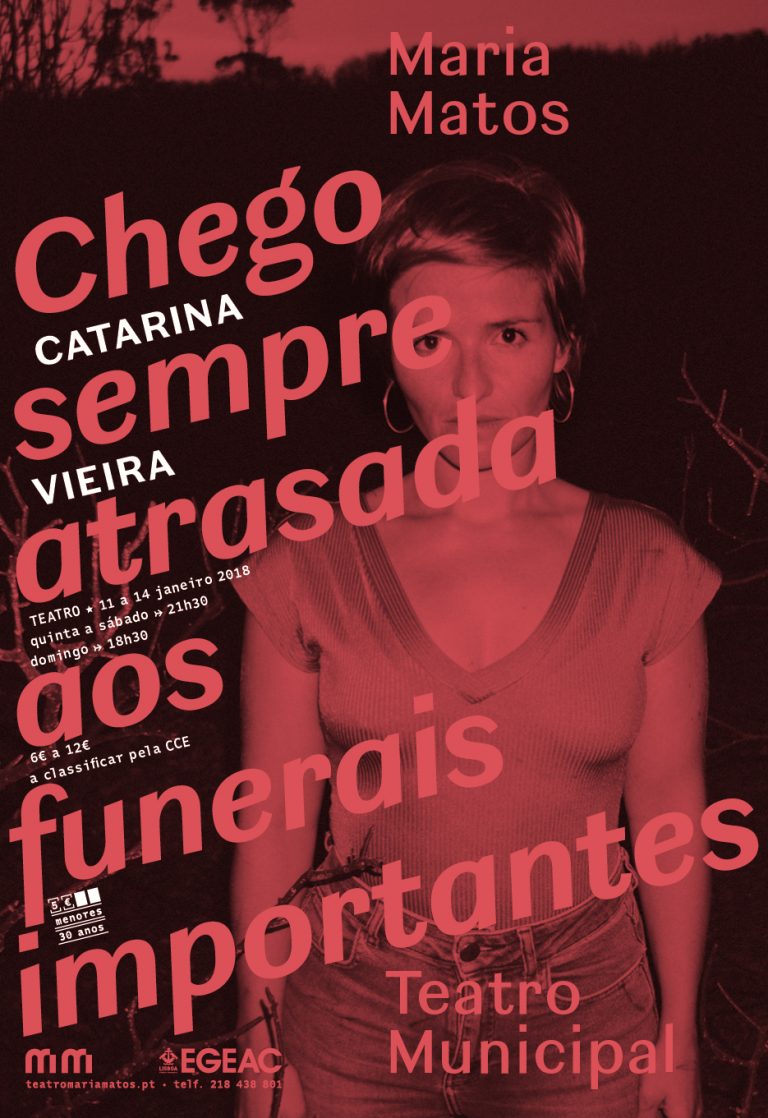
Catarina Vieira
There is no place to hide. The world is already there.
The research process, which are now evolving into the performance Chego sempre tarde aos funerais importantes has been an affectionate attack on frontality, representation and the idea of love as a merging of two souls.
The body is never alone, we are perennially more than one – there is always a displacement, a shifting, in-between these sensuously thinking beings, which we are. Perhaps this displacement, this crack, is where desire flows from. Perhaps this is where pleasure happens.
These sentences are what I think of, when I think of Catarina Viera’s work. In her research she has focused on two things: 1) to create from desire and 2) to draw material and inspiration from one-to-one encounters.
In terms of the latter, she created the format of a micro-encounter, a performative and poetic moment spend with one other person. In terms of the former, the encounters investigated such “strategies” as: dancing from pleasure and collectively dreaming – in other words, letting the encounter of two bodies, two imaginations, and two lives run free in an explorative orbit around each other. Conducting these micro-encounters in Amsterdam, Chile, and Lisbon, material started to take shape. Questions started to form. How do human beings share touch and desire? Does it necessarily imply a sexual or romantic relation? And if not, is there then – as Deleuze and Guattari already suggested in 1980 – a joy immanent to desire? A joy related to touch, to movement, to imagination, but in a way that never stops and never seizes to transform and disperse.
Chego sempre tarde aos funerais importantes attempts to bring the ritual intimacy of the micro-encounter onto the stage. It does not make spectators into performers, nor performers into spectators, but it searches for a haptic space. A space, where a gaze is as physical as touch to the skin or the movements of the body. A space, where desire is shared, not as a kapow-escalation plunging into a (theatrical) orgasm, but as a disruptive stream of intensities and phantasies – whirlpools, waterfalls, disparate currents.
Does pleasure really equal climax and satisfaction? Perhaps this is an old idea of pleasure that it is time to do away with.
Time to step into the stream.
Jonas Schnor
Return to Self
The process with Catarina was a joy and a challenge and certainly revealed a host of other dramaturgical possibilities to equip my craft.
I had never even heard of a micro-encounter until I met Catarina.
It was clear from the outset that she had a range of ideas with which to swim, both with and against the tide. Many textual sources (where from, however, is still unclear to me) were used in the composition of the process. We had the privilege of being to actively engage in the process of Catarina’s work as a participant in one of her many individual micro-encounters. During which, we shared questions with each other, danced in an act of ‘pleasure’ and engaged in a pre-prepared activity with each other (for which, I decided to share my knowledge of the Welsh language).
Having engaged in a workshop with dramaturg Konstantina Georgelou, we as aspiring dramaturgs were given the opportunity to engage in a collaborative process in which we would become integral to the compositions of dramaturgical concepts.
Judith, Joe and I then embarked on a dialogue with Catarina individually as well as with each other on how to place emphasis within the presentation of our concepts. I cannot speak for others, but the emphasis on the return to one’s self became prevalent for me; how the lonely hero goes on a long journey to find one’s self.
Even as eyes are closed, pleasure-dancing with a complete stranger – then this idea becomes clearer. The return to one’s self is when one can become honest. Sharing of questions made us open to one another, thus, discovering and re-discovering, allowing the process of personal engagement to influence the dramatic emphasis on the unification between audience and performer.
When it became clear that there would be a connection with the audience physically, with more of reference to touch and feel, then the micro-encounter became clearer. The process with Catarina made clear the notion of what we were to achieve.
If more time was dedicated, as in, more weeks of solid development and fermentation, then I feel more of a progression into our final concepts could have been made. Two shortfalls. Firstly; the limited time that was made available to the dramaturgs. Secondly,; a difficulty working in a group and would have found it more beneficial to be one’s dramaturg to one’s project.
Having also seen the test presentation at Das Arts, it was refreshing to see a development in the flesh of work which had only been hypothetical to us as dramaturgs in our own company.
A final note; we understand ourselves as dramaturg’s to position ourselves as the outside eye of the performance. As the catalyst for dramaturgical process. As the ‘bird’s eye’ view. The separation from form and content.
Having actively engaged within Catarina’s process as a dramaturg we have had a greater understanding of how this process has begun as a seedling in the mind of one individual in to a whole garden of possibilities because we have shared in that process. That’s how an audience can be made to feel in this performance. The question posed therefore is whether dramaturgically we can actively immerse ourselves in a process-led dramaturgy rather than simply disengage in order to sustain possibilities.
As an active dramaturg, possibilities became less thought and more action.
Below is the concept which I presented:
How does it feel?
To be on your own?
With no direction home?
Like a complete unknown.
Like a rolling stone.
I’ve been listening Bob Dylan’s 1965 song ‘Like a Rolling Stone’ all the way through this process. There’s something that echo’s in these lyrics.
The first text used as research that we read is entitled:-
TRAPPED IN A COUNTRY CALLED ADVENTURE. THE ADVENTURE OF OUR TIMES
It opens like this:
‘You are blind, being led by an invisible hand’
‘Abandonment is the ontological condition of our times.’
If we begin with this notion, then what we receive an understanding of how this performance may engage with its audience. We are led to understand that the hero must go on a journey. How do we project the hero’s journey through a contemporary understanding of modern mythology? If abandonment is then ‘the ontological condition’ then how do we ‘abandon’ the audience?
This concept can be assisted by the use of several key terms:- SKIN TOUCH THRESHOLD
Another text used as research; ‘Motel Buenavista’) speaks to someone who undertakes the process of a change. Why do we change? Do we force ourselves to change? Why is it that ontologically we experience a process of change?
SEPERATION INITIATION RETURN
The separation is a separation from the self. The initiation is the execution of the change in its very precise moment. Then the return manifests itself as the return to one’s self.
How does this help us to construct narrative?
– How do you separate the spectator from their own self’s?
– How does the initiation of a change then occur?
– How do the spectator’s return to themselves?
– Do you have to take something to begin with in order to return it and re-evaluate it?
THRESHOLD
What does an audience enter with? An open mind? Pre-conceived ideas? Their bodies. Their senses. Their very centre of their being. Their AXIS MUNDI. The axis mundi of our contemporary mythology is that of the self. The centre. Once the divine sentiment of the axis mundi is lost, then the unification of humanity is the answer.
SKIN
Take away the senses from the audience and allow that invisible hand to guide them. Make them abandon themselves. How do you achieve this performatively? Loosing one’s sense of seeing can be as little as turning off the lights to performing behind the spectator (although this would have its hurdles if the audience are now situated in the round).
To hear? Can the performers hear music integral to a scene/series of actions (also integral to the audience’s ear)?
Dramaturgically, how do you ask the audience to abandon themselves? The micro/macro encounters aren’t so simply executed when resonated within a performance context. Audiences are unpredictable, judgmental and reserved until you break those shackles yourself.
Jonathan Burrows calls this initiation a ‘contract’. If an audience understands its contract from the very moment they enter the theatrical ritual (be that inside or outside the performance space, or beyond) then it is signed by both parties and the performance and the context is set for the remainder of the performance.
TOUCH.
Lead the audience through an experience in which they will loose a part of themselves, allowed to be led blindly on a journey and then have the ‘lost’ part returned to them through the initiation of a significant change in self. Like the hero’s journey, the audience can find themselves. Answering what the audience’s change would be during the performance would be only answerable by them.
Sound & Fury’s 2012 production of ‘Going Dark’ followed the journey of a planetarium coordinator who slowly looses his sight. As his sight deteriates, so do the technical specifications. Lighting becomes dimmer, gradually realising a total blackout for both performer and audience. But sounds becomes amplified, crystal and dynamic. The spectator’s deprivation of vision becomes integral to the narrative in that the immersion of wholly humanistic fear is shared and thus, supports sympathy.
SEPERATION
THRESHOLD
INITATION
SKIN
RETURN
TOUCH
How does text appear in the performance (given that a variety of texts have become inspirational to the thinking of Catarina’s work)?
David Mamet always tells us that a character should only speak in a play if there is an intention. In a very Austinian approach, without the intention, there is no impulse to speak. So, finding the language of the performance is crucial.
What text might benefit the CONTRACT of the performance? That all depends on the story that you wish to tell (should there be a story at all). Text can only be a supplement for the other language you choose to communicate in during the process. The language of dance for pleasure (speaking from experience) is a clearer language than anything that can be manifested into words.
If text is used as ways of being able to construct segments of performance, then how do they offer themselves as suggestion/instruction for other languages? Choreographer Imogen Knight uses these segments of suggestions in texts as a way of understanding how it can inform proximity between spectator, space and performer.
As such, the ADVICE FROM THE HELPERS is a consumet way of informing the language of dance for pleasure.
You have to get lost.
You have to kill your old SELF and recreate your self as a project.
You have to be blind.
You can’t look back.
You have to discover unknown territories, knowing that there are no territories left.
You have to leave your comfort zone.
You have to risk more.
You have to be ready for any scenario.
You have to change constantly.
You have to adapt to permanently changing conditions.
You cannot rest.
You have to be exciting.
You have to be sexy.
You have to have pleasure. Enjoy.
And so fourth, and so fourth…
Thus, one of many dramaturgical solutions for such a performance would be to SEPERATE the audience’s experience of pleasure by removing one of their senses. Allow performance to initiate a change through action, dance of pleasure, moments of encounters…
TOUCH
SKIN
THRESHOLD
Then occur a RETURN by allowing an engagement somehow in the audience’s senses.
Christopher Harris
Sunday → 6.30pm
Under 30 years old: 5€
Under 18 years old: 3€
Sinopsis
“What kind of world does one see when one experiences it from the point of view of two and not one? What is the world like when it is experienced, developed and lived from the point of view of difference and not identity?”
Alain Badiou
I always arrive late for important funerals explores the tensions between the narrative of the solitary hero — who must always be prepared for everything and who ventures into the unknown — and the territories where the ideas of preparation and heroicness are perhaps absurd and problematic: love and death.
This project involves research into the iconography of the solitary hero, who is called upon to abandon his world and head off into the unknown, on a journey where he will face different and dangerous ordeals, aided by his magic powers. As this is an old narrative linked to the rites of passage in different cultures, this myth also seems to perpetuate itself in our collective imagination and in neo-liberal rhetoric. This, in turn, is linked to the figure of the free explorer, the courageous and enterprising adventurer who ventures into unknown territory: richer and happier.