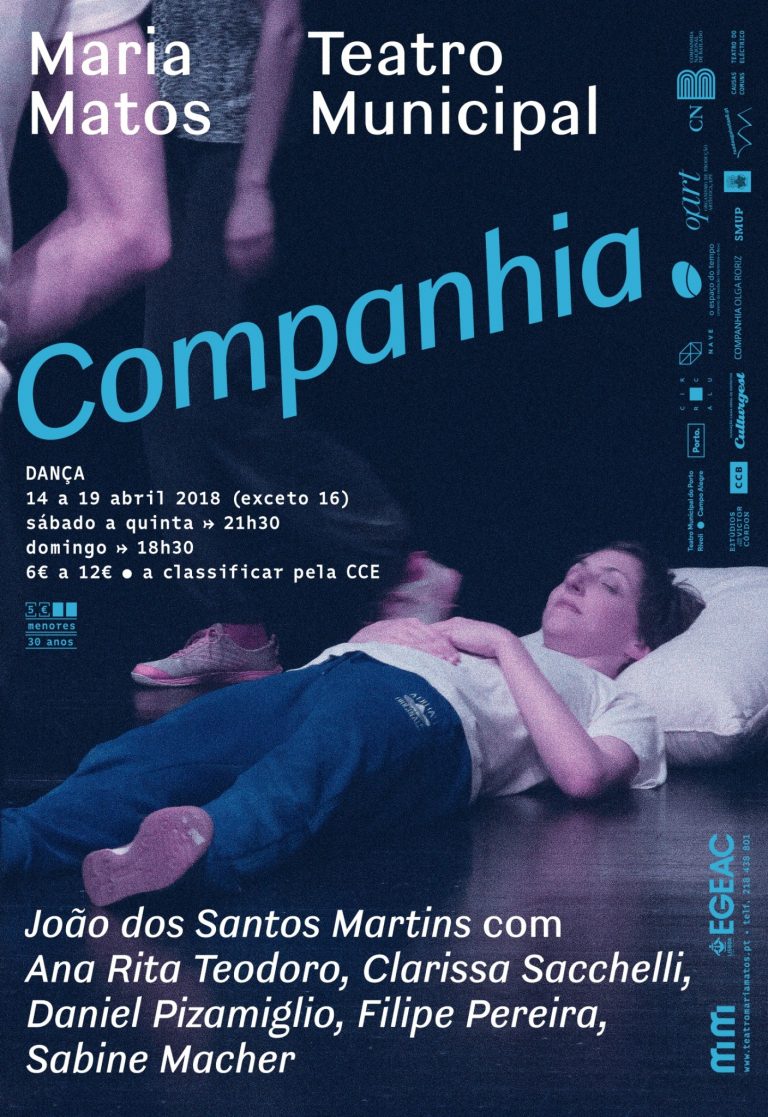
João dos Santos Martins with Ana Rita Teodoro, Clarissa Sacchelli, Daniel Pizamiglio, Filipe Pereira, Sabine Macher
Biography
João dos Santos Martins was born in Santarém (Portugal) in 1989. He holds a BA in Dance from Lisbon’s Polytechnical Higher School of Dance (2007-10) and a MA on Choreographic Studies from Université Paul Valèry III/ex.e.r.ce, program directed by Mathilde Monnier. He also attended Codarts (2010), P.A.R.T.S. (2010/11) directed by Anne Teresa de Keersmaeker and the MA for Choreography and Performance from Justus-Liebig-Universitat Giessen (2012) under the direction of Professor Bojana Kunst.
He works as a dancer and choreographer since 2008, often articulating his practice in several collaborations expressed in pieces such as Le Sacre du Printemps (2013), co-directed with Min Kyoung Lee, Masterpiece (2013), Continued Project (2015) — Authors SPA Award 2016 —, Autointitulado (2015) with Cyriaque Villemaux and Anthroposcenes (2017) with Rita Natálio.
Recently he has been regularly collaborating as a dancer and performer in projects by Eszter Salamon and Xavier le Roy and in 2017 he performed Self-Unfinished by Xavier Le Roy at the Venice Dance Biennale. Previously he has worked with Richard Siegal, Rui Horta, André e. Teodósio, Cão Solteiro, Felix Ruckert, Ana Borralho e João Galante, among others.
His work also includes the adaptation of Deborah Hay’s “Conquest” (2010) solo, the reconstruction of Yvonne Rainer’s Continuous Project Altered Daily (1970 – 2011) in collaboration with ex.e.r.ce students, Xavier le Roy and Christophe Wavelet, and the choreographic production of Tropa Fandanga (2014) by Teatro Praga.
He was commissioned work for Oldschool#40 arts program in Lisbon and for Azores Walk&Talk 2016. In 2016, he was invited by the Viriato Theater to direct Vera Mantero, João Fiadeiro, Clara Andermatt and Paulo Ribeiro at a reunion event where, along with Ana Bigotte Vieira, he elaborated the premises for the project of collective historicisation for dance in Portugal “For a Timeline To Be — genealogies of dance as an art practice in Portugal”.
In 2017, he curated cycle “New—Old Dance” in Santarém, in which he continued his research on discursive traits of dance history through a program of exhibitions, talks, workshops and shows.
João dos Santos Martins is a recipient of a merit grant from ESD-IPL 2008/09, he was a fellow of the danceWeb 2010 program, and scholarship recipient of the National Culture Center (2010), the ENPARTS (2010/11) and the Calouste Gulbenkian Foundation (2011-13 ). He currently is “resident artist” of the Circular Cultural Association and runs the Parasite Association (founded in 2014). His work was presented in Portugal, Spain, France, Belgium, Austria, Romania, Brazil, Mozambique, Uruguay, Chile, Republic of Korea and New Zealand.
Sunday → 6.30PM
Under 18 years old 3€
Under 30 years old 5€
Sinopsis
Company marks the re-encounter of João dos Santos Martins with the team from Projeto Continuado (Continued Project, 2015), giving continuity to the processes of collaboration and research begun at that time and marked by relationships of labour and affection. Company invests aesthetically in the idea of dance as work, using, for this purpose, case studies that, for example, examine the systematisation of the movement of factory workers in relationship to machines, from which emerges a concept of choreography as technology or as a prosthesis. In parallel, it reflects on how certain aesthetics related to dance, with libertarian and democratic ambitions, are involved in the reduction of stress points in the body, implementing techniques of efficiency in the performance of a gesture and the use of energy, leading to the reduction of effort as an alternative to the rigid “modernity” that is ideologically “exterior” to the body.
With this in mind, Company attempts to reflect both on work and well-being, considering the way in which dance, as a canon of production of reciprocal pleasure (of the spectator, but also of the dancer) and thus difficult to identify socially as labour, interacts with its ways of doing. And while the idea of “company” invokes here an hegemonic form of structural and administrative organisation in dance, it also implies a common mode of labour: company as a fact or a condition of existence and of being with the other, as a way of providing friendship or pleasure to a group of people in a society.